
Instrument · Coming Autumn 2026
Pulsar Hell
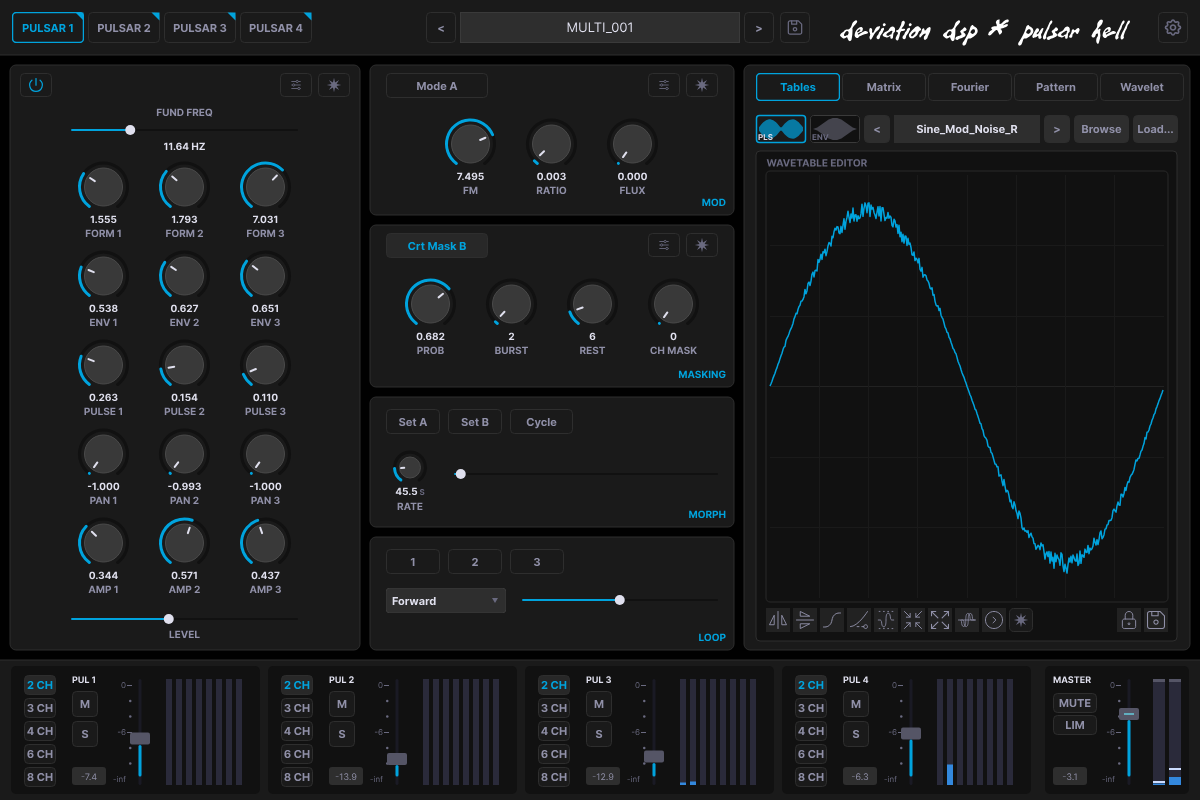
Pulsar synthesis. Four independent trains, a wavetable system, and the Fourier, Pattern and Wavelet editors.
The grain model
01
Built from grains
Each pulsar has two parts. The pulsaret is a waveform that loops inside the grain. The envelope plays once and sets the grain's length and shape. The output is their product.
Fund freq sets how often grains fire. At a few grains per second you hear separate events; in the audio range they fuse into a pitched tone. Formant sets how fast the pulsaret is scanned, so tone color moves independently of pitch.
grain length = 1 / (fund × formant × env)
cycles per grain ≈ 1 / env
Inside the instrument
02

4 trains, 4 rates · train 3
4 trains
Four complete voices sound at once, each with its own wavetables, modulation, masking and channel routing.
Trains

pulsaret·window·one grain
918 wavetables
918 factory tables in 32 categories, plus your own WAV, AIFF and FLAC files, resampled to 2048 samples.
Tables

fourier·pattern·wavelet
5 editors
Five editors: Tables, Matrix, Fourier, Pattern and Wavelet. Build a waveform from 32 harmonics, gate grains with a Xenakis sieve, and recolor them with wavelets.
Editors

next grain, next channel
8 outputs
Each train renders into 2, 3, 4, 6 or 8 channels. A channel mask moves successive grains through the field.
Outputs
Packs and journal
03

12 tables, sine to saw · table 8
PacksIn preparation
Wavetables and presets built for this engine
2048-sample tables and presets for all four trains, sold on their own. None have been released yet.
Autumn 2026

one train, sixty years · now
LatestIn writing
Pulsar synthesis, from Xenakis to now
A history of the technique: Xenakis, Roads, and ten years of performing with Pulsar Hell in beta.
Autumn 2026
Instruments
04